
Doctors Named This Condition in 1895. Most Women Still Have Never Heard of It.
Musculoskeletal syndrome of menopause may explain why your knees are acting up.
MenoKnee Sleeve
MenoKnee Sleeve
Doesn't fit right? Free exchange within 60 days, no questions.
🎯 Targets Exactly What Causes the Pain
🏋 Exercise Without Pain the Next Day
😎 Keep Doing the Activites You Love
🔋Easy Fit, Easy Wash
Shipping
Shipping
Shipping takes 8-12 business days.
Customers typically report the lower end.
Couldn't load pickup availability
MenoKnee Sleeve

Does Any of This Sound Like You?
Your knee feels fine at the start of a walk, then complains on the hills, or the stairs.
Maybe you've been fine the entire day, only to wake up the next day with super stiff the next day?
Have you started planning routes, and even days, around how your knee might behave.
You've tried a sleeve before. It rolled down or cut off circulation at the thigh.
You've wondered if this is "just aging," but it started faster than you expected, and it doesn't quite add up.
If any of that sounds familiar, you're not imagining it. And you're not alone in it.
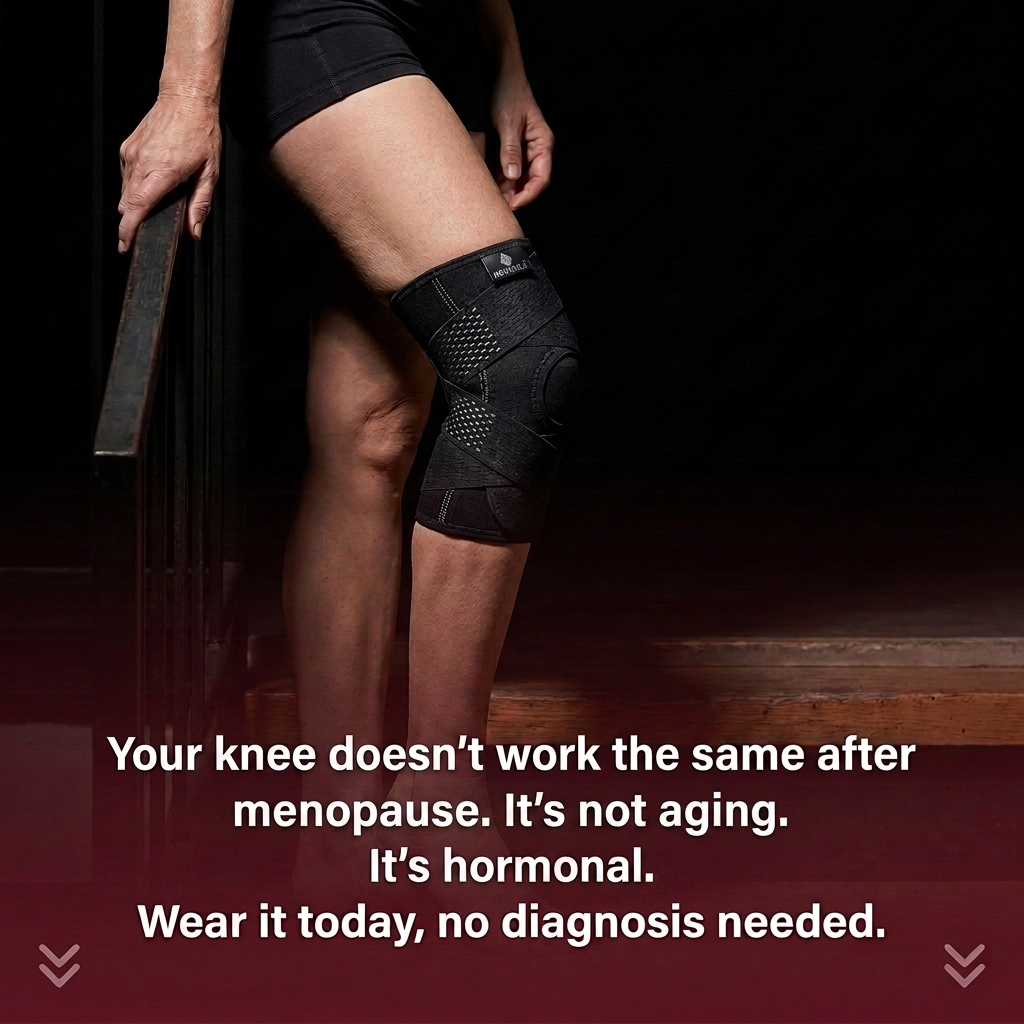
It's Not Just Aging. It's Hormonal, Too.
Declining estrogen interacts with muscle, tendon, cartilage, and the pathways that regulate pain throughout the body.
That can quietly narrow the gap between the activity you tolerate and the activity that triggers a flare, often with no new injury at all.
And exercise is frequently the moment that narrower margin gets tested.
Doctors first described a menopause-linked joint condition back in 1895.
It disappeared from mainstream conversation for over a century.
Researchers only gave it a modern name, musculoskeletal syndrome of menopause — in 2024.
You didn't miss something obvious. Medicine is still catching up on this one, too.
You're Not Done Moving.
Your knees might just need the right kind of support while you do it.
-
Steadier on Stairs and Hills
MenoKnee is designed to give you a felt sense of stability during the exact movements that usually give your knee trouble.
-
Built for the Body You Actually Have
Most sleeves are designed around a generic measurement. That's why they roll down, cut off circulation at the thigh, or sit loose around the knee. MenoKnee is built around real thigh-to-knee-to-calf proportions, not a generic unisex leg.
-
All-Day, Every-Day Comfort
MenoKnee is built with breathable material designed to move with you from a morning walk through an afternoon of errands, discreet enough to wear under leggings or pants without anyone noticing it's there.
Hear From REM-Maximizers
-

★★★★★
From Falling Behind to Leading the Room
“I was exhausted and hiding it in every meeting. Once I started sleeping through the night, I became sharper, more confident, and trusted with bigger decisions. Three months later, I was promoted to Senior Product Manager.” -

★★★★★
From “Nothing Works” to Leading Our Biggest Account
“Melatonin left me foggy, my Oura score made me anxious, and every mask leaked. Once the light was finally sealed out, I stopped waking up depleted. Now I lead our highest-value account.”
-

★★★★★
Burnout Fear to Vice President
“I looked successful but felt like I was running on fumes. Waking up clear gave me the energy to speak up, mentor others, and take ownership again. This quarter, I was promoted to Vice President.”
-

★★★★★
Looking Exhausted to the Obvious Promotion
“I feared looking tired in front of the people deciding my future. Better sleep made me calmer with clients, faster with decisions, and consistent under pressure. When a director role opened, my performance had already made the case.”
-

★★★★★
From Sacrificing Sleep to Leading the Team
“I thought sleeping less would help me get ahead. It only made me slower and easier to overlook. Now I think clearly, handle pressure better, and lead the team my coworkers want to join.”


Frequently Raised Concerns
Why does this mask have sound if sound can mess up REM?
Why does this mask have sound if sound can mess up REM?
You are correct to ask this. REM is especially sensitive to sound. However, it is shown in research that REM is disturbed by sudden noises, and a constant frequency or type of music will typically shield your brain from sudden noises.
Do I need to charge or pair anything before bed?
Do I need to charge or pair anything before bed?
It is recommended to charge your mask every morning, so it is ready for use at night. This is just so you don't run the risk of the mask dying in the middle of the night.
Pairing your phone to the mask is recommended, but not required.
Will the audio hardware bother me if I sleep on my side?
Will the audio hardware bother me if I sleep on my side?
This was a complaint we saw appear time and time again. Seeing those complaints, we decided to really put effort into padding the areas near the hardware while still keeping it audible.
How is this different from a $13–$40 blackout mask?
How is this different from a $13–$40 blackout mask?
Most masks in that range block the room but not the eyelid-level gap, especially at the nose bridge — the point reviewers across the category report light leaking through most. REM Seal is built specifically to close that gap, along with the sound gap most masks don't address at all.
What's your return policy?
What's your return policy?
60 Day Money Back Guarantee. No questions asked.
Is the science real?
Is the science real?
Yes, here are part of the resources we used in the development of this product:
Figueiro, M.G., & Rea, M.S. "Preliminary Evidence That Light Through the Eyelids Can Suppress Melatonin and Phase Shift Dim Light Melatonin Onset." BMC Research Notes, 2012, Vol. 5, p. 221. DOI: 10.1186/1756-0500-5-221
Buxton, O.M., Ellenbogen, J.M., Wang, W., et al. "Sleep Disruption Due to Hospital Noises: A Prospective Evaluation." Annals of Internal Medicine, 2012, Vol. 157, No. 3, pp. 170–179.
Messineo, L., Taranto-Montemurro, L., Sands, S.A., Oliveira Marques, M.D., Azabarzin, A., & Wellman, D.A. "Broadband Sound Administration Improves Sleep Onset Latency in Healthy Subjects in a Model of Transient Insomnia." Frontiers in